

We like big bots, and we don’t like lies!
Takeaways from our panel on chatbots, consent, and authenticity in AI marketing

A small claims tribunal in BC wasn’t supposed to decide one of the defining questions surrounding AI. But when Air Canada’s chatbot made a promise the company wouldn’t keep, it triggered a ruling that set a precedent: you’re responsible for what your AI does.
That case opened our Ethics of AI in Marketing Tech Thursday panel on April 30th, and set the tone for the evening’s discussion.
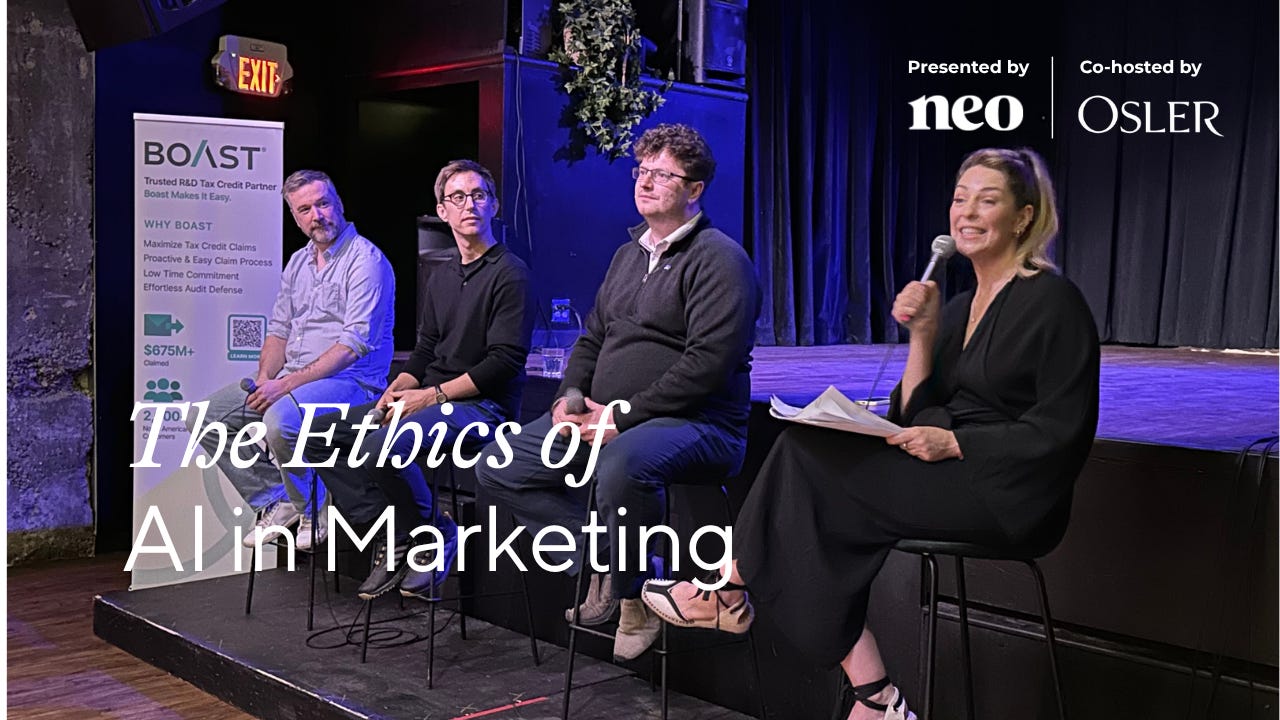
Three different experts whose work lies in the consequences of post-AI deployment were invited to weigh in: Professor Noah Castelo, who researches consumer trust in AI at the University of Alberta; Adam LaRoche of Osler, Hoskin & Harcourt LLP — a data and privacy lawyer for some of Canada’s largest companies; and Bob Evans from Wisdom, who’s spent 10 years building conversational AI products for Intuit and Jobber.
Here’s what surfaced 👇
1. “You know you messed up when you’ve got a problem named after you.”
Evans was building an internal chatbot at Jobber when the news broke about Air Canada’s fail. “In the office, we called it the ‘Air Canada problem’, and we discussed how to avoid it. Basically, we concluded: don’t give it information it doesn’t need. Anything you hand it that isn’t required for its core function increases the probability that it’ll use that information to do something destructive.”
“If you don’t want your bot to talk about pricing information and you give it pricing information, chances are it’s going to talk about pricing information.” - Evans
LaRoche was clearcut with his own advice: “A chatbot essentially acts as your agent. If it makes a commitment to a customer, that commitment is yours. Disclaimers help. Strict parameters help. But there’s no magic language that makes the liability disappear, particularly when a judge is sitting across from a customer who relied on what the bot told them.”
“My experience with judges is that they’re people too. They’re going to side with the customer most of the time.” - LaRoche
2. “People attribute the use of service bots to cost-cutting at the expense of quality.”
This brought us to Klarna — a company that learned its lesson the hard way. In 2024, the company fired around 700 customer service staff, replaced them with chatbots, announced major efficiency gains… and then rehired them. The bots were missing the mark with customers.
Castelo wasn’t surprised. His research finds that people rate bot service lower than human service, even when the service quality is word-for-word identical. That’s because customers assume the bot was deployed to save money, and they interpret that choice as coming at their expense.
“That cost-cutting attribution is one part of it. But also, people have a lot of experience with incompetent bots that can’t solve their problems as effectively as a human can. That’s a really hard perception to counter.”
There’s one exception, added Castelo. When a bot is unambiguously better than a human (faster, more accurate, less grumpy at the end of a long Wednesday), satisfaction goes up. “Expedia’s flight-change bot is one example. You don’t have to wait on hold. It’s immediate and unambiguously better.”
Brought to you by:

Osler is a leading business law firm uniquely positioned to advise Canadian, U.S. and international clients on an array of domestic and cross-border legal issues. Learn more here.
3. “Brenda was a Bot. I felt betrayed.”
While chatbots can be more efficient, it’s also become increasingly difficult to decipher man from machine. What happens the moment a customer realizes the voice on the other end of the line, the one they’ve just apologized to for interrupting mid-sentence, isn’t actually “listening”, but rather just predicting the next token in a sequence?
We discussed the story of how I answered what I thought was a regular customer service call. I was hands-free in the car with my toddler in the back seat. Brenda, the voice on the other end, sounded a little hoarse, like they might have a cold. I felt a little sorry for them. Then I went off-script.
“I have to go. My daughter just threw up in the back seat.” After a brief pause, Brenda’s reply was to offer me 40 gigabytes of free data per month. I suddenly realized I was talking to a bot. I felt betrayed.”
It’s a difficult thing to describe, but Evans knew what I meant. He’d watched that exact problem play out at scale. Over 50% of calls to the AI receptionist system he built were ended in the first 15 seconds — people hanging up the moment they suspected they weren’t talking to a human. Even though 95% of those callers’ needs could have been resolved quickly and easily.
“As the person building and deploying this tech, it puts you in a weird spot. You ask yourself what you’re really building. Are you building something specifically to trick people?”
For most, the answer would be “Not intentionally.” But the pressure to increase engagement is only mounting, and the gap between what a well-designed AI can do and what people are comfortable letting it do for them is still really wide, which is where ethical and legal questions of disclosure tend to seep in.
The question turned to whether we could resolve ambiguity through disclosures. Evans wasn’t so sure. “At Jobber, we had to decide whether to tell callers they were speaking to an AI bot. The law was murky. It wasn’t an easy decision; every time we disclosed it was AI, people hung up. We chose to disclose anyway.
“There was a time when the bottom line was pushing against morality. We held the line.”- Evans
4. “People still want to know a human was involved in the creation of what they’re consuming.”
And then there’s the question of copyright. Stability AI, for example, was trained on Getty images. The tell was in the watermarks it absorbed and reproduced without understanding what they were. This cracked open a conversation around consent, transparency, and where Canadian law currently stands on these issues.
“The problem is that these are live issues,” LaRoche weighed in, “The courts are still catching up. The fundamental training data problem has two layers: terms of service that prohibit scraping, and reproducibility, when the output is close enough to the original that infringement becomes visible.”
He drew a useful line.
“Not every AI interaction needs a disclosure. Helping someone reschedule a meeting? Probably fine. Declining someone’s refund request? That’s when you’re getting close to the fundamental interests of the individual, which is where transparency starts to matter legally and morally.” - Evans
Castelo found a similar parallel in content generation. His research shows that AI-generated articles aren’t rated lower than human-written ones… unless readers know they were written by AI. “The knowledge of the author’s identity is key.” That’s why there’s a growing movement toward certification, logos, or some other legible signal that something is human-made. “People still want to know a human was involved in the creation of what they’re consuming.”
5. “The only reason AI tools are helpful in my practice is that I already know the answer.”
The panel closed with a question that’s on everyone’s minds: jobs. Will we still have them? McKinsey projected that by 2030, 30% of US work hours could be automated. Women are 1.5 times more likely to be impacted. Low-wage workers, 14 times. The three panellists had consistent instincts about what matters in today’s job market.
“I think oral communication skills are going to be important even in a world of AI,” said Castelo,
“Claude Code can legitimately do pretty much everything a college graduate can do now. So, being able to distinguish high- and low-quality AI output is what’s needed.” - Castelo
LaRoche agreed. “You can tell within the first 30 seconds whether it’s a workable product or not. The only reason AI tools are helpful in my practice is that I already know the answer. I need it generated quickly, and I can validate the output.”
“My advice to people would be to automate the things you’re already good at,” added Evans, “If you’re automating things you’re not good at, you’re never going to get better. I’d way rather have a junior PM produce a lower quality artifact that they sat and thought about before going to ChatGPT.”
The common thread taken from this discussion is that AI is only as good as the judgment behind it. You have to know your craft before you can tell when the tool is getting it wrong. Every case study we discussed, from Air Canada to Brenda, came back to the same question: do your customers trust you? And more specifically, are you giving them a reason to?
 | A guest post by
|