

Edmonton Is Already Building the Future. It Just Hasn’t Told Anyone.
Takeaways from our Tech in the City panel on permits, platforms, and the need for greater confidence

“Wait a week.”
That’s what the cab driver said when Murtaza Haider commented that it was nice out after landing at Edmonton International for the first time.
Haider is a Data Science and Real Estate Management Professor who’s spent the last 30+ years studying how cities grow. He’s looked at the numbers up, down, and sideways, and he’s compelled by what he sees: Alberta’s population is expected to grow from 5 million to 7.5 million by 2050, with a million of those new residents settling in Edmonton. This means the city must dramatically increase housing supply. It’s an all hands on deck situation, and it’s a major reason why he relocated to YEG in the first place - he’s been selected as the Executive Director of the Cities Institute, a University of Alberta initiative focused on city-building research and collaboration across academia, public policy, and industry.
Haider moved here on purpose, with a purpose, betting his career on this city’s growth. And the first thing he heard was: Don’t get your hopes up.
“In New York, the cab driver upsells the city to you the moment you land. We have to believe in this city. We have to own it.”
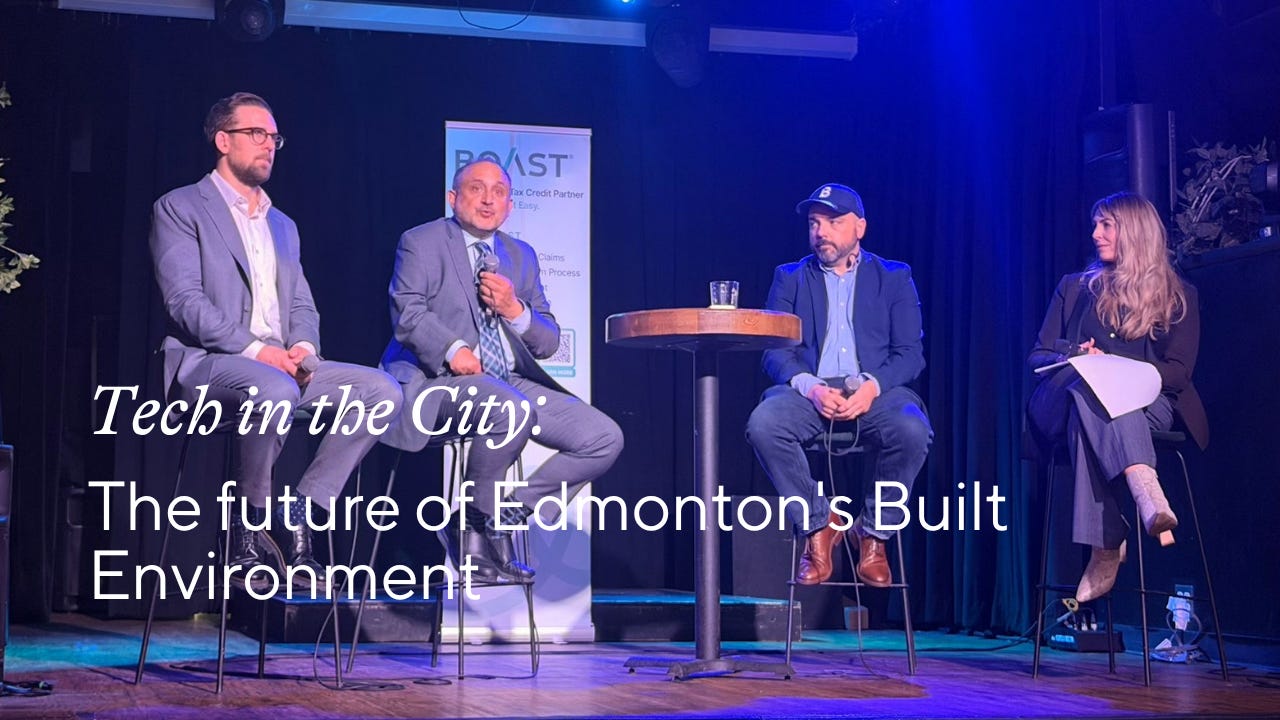
That reflex to undersell before anyone gets too excited was flagged multiple times in various ways at Tech Thursday on the 23 April.
1. “I gave up. And that’s not good.”
Alex Gosselin is a good example. He spent 10 years at Rohit Group fixing problems no one else had tackled yet. He transformed Excel inventories into a database, an ERP, portals for site supervisors, a customer-facing purchase app — until all those fixes added up to something sellable. That’s how Rohit Group’s internal startup, Buildbase, was born. The company’s software now saves homebuilders a significant amount of money across North America by streamlining construction workflows, cutting administrative overhead, and reducing errors across sales, construction, and finance.
But despite building a successful product, Gosselin and his co-founders had little success raising money locally.
“I applied to around 30 funding programs... I gave up. And that’s not good.”
Gosselin and his co-founders poured $8 million of their own money into the business rather than waiting for a system that wasn’t designed for companies like theirs — too real for early-stage investors, too small for late-stage ones. “The worst thing you can do is wait and watch,” Gosselin said. “Others will get there faster, cheaper, better.”
He wasn’t just talking about his competitors.
2. “What’s the value of sending a trained urban planner to look at the same designs all day?”
While Buildbase was silently solo scaling, something else was happening inside the city that most Edmontonians don’t know about.
Mike Kluh is the Director of Business Performance at the City of Edmonton. Four years running, by objective measure from the Canadian Home Builders Association, Edmonton is the best in the country at turning a housing application into a decision. The way they got there was by doing something no other city had thought to do: when they rewrote the zoning bylaw, they wrote it to be read by a machine. Now, thanks to automation, around 70% of single-family home development permits in Greenfield areas are processed with no human in the loop, turning a lengthy wait into a matter of minutes.
“We didn’t say to the public, we don’t care about your setbacks anymore,” Kluh says. “We just asked: what’s the value of sending a trained urban planner to look at the same handful of housing designs on a pre-planned subdivision all day?” Kluh’s team also trained an AI model to predict inspection outcomes. If the data says you’re going to pass, the inspector doesn’t come.
Since 2021, this more efficient permitting process has saved the community 165,000 days of delay and $16 million annually.
And this is just one example of how Edmonton fixed something no one else had fixed and built software around it - software that’s now sold across North America by Computronix.
Brought to you by:
Boast - Are you leaving innovation capital on the table? Boast combines AI-powered automation with specialized tax expertise to help tech companies maximize R&D credit returns. Join 2,000+ businesses who’ve secured $675M+ in funding. Get your free assessment at boast.ai

3. “If you don’t occupy downtown, someone else will.”
But not every fix works the way it’s supposed to, a fact our panel didn’t shy away from.
Haider told a story about a city that built an app to detect potholes through smartphone sensors and automatically dispatch repair crews. It worked exactly as designed. Potholes got fixed faster… but only in wealthy neighbourhoods, where residents had the right kind of phones. The poorer streets stayed be-holed.
The City of Edmonton ran into a similar issue when building its inspection prediction model. A data scientist noticed the model knew contractor IDs. If it also learned company names, it would start predicting outcomes based on cultural patterns in those names. It systematically baked discrimination into a system that looked completely objective from the outside. Luckily, Kluh’s team caught it before it went live.
“You have to be very mindful of what you’re training the model on. It might appear to be making objective decisions, but it might also, without you knowing, be building bias,” says Kluh.
This brought Haider back to Edmonton’s downtown. The homeless population in Toronto is roughly comparable to Edmonton’s per capita. Except, in Toronto, it’s less noticeable because its downtown is so dense with offices, residents, students, and foot traffic. In Edmonton, those with a choice decided to stay away, leaving Jasper Ave and its surrounds occupied by those who don’t have anywhere else to go. “If you don’t occupy downtown, someone else will,” he added.
Though opting out feels like a neutral decision, it really isn’t. Cities are living systems; they respond to where people put their energy, their money, and their presence. Haider believes Edmonton has the opportunity to reclaim that, but it requires collective action.
4. “Don’t worry about jobs. Worry about opportunities.”
The panel closed with questions from an audience featuring young people worried about finding work in a tight market. Haider’s response was practical: “Don’t worry about jobs. Worry about opportunities.”
He recalled how one student applied for a job that didn’t exist in his lab, got a slow response, and showed up at his office door anyway. “That was the best conversation I’d had all week. That student was working for me the very next day.”
Gosselin’s had a similar take on showing initiative. “When I want to land a client, I send them my resume, and I build them something small that I know they need - a little app or a prototype. It’s around two hours of work and you capture their attention,” he said.
“Everyone has a problem. So, what if you showed up with a solution?”
Kluh’s advice was even simpler: “Go to events like this. Meet people. Learn what they do. Put yourself out there.”
5. “The worst thing you can do is wait”
Edmonton is already number one in permits. It already built software the rest of the continent uses. It already produced a homebuilding platform operating across North America. It has a professor who left Toronto to bet his career on this city’s growth, a senior city official rewriting what government can do with data, and a successful founder who kept building through 30 rejections.
The cab driver said wait a week.
Fortunately, these three didn’t.
Coming up at Tech Thursday:
🎉 May 20th - Upper Bound After Party
Co-hosted by: Boast, Artemis Canada, AEC and RBCx.
Upper Bound is almost here! On Wednesday evening, we're taking it off the conference floor and bringing everyone together for an After Party. Open to all conference attendees and the broader Edmonton tech ecosystem.
The event is currently sold out, but we’re working on increasing capacity. Join the waitlist to be first in.
 | A guest post by
|